The most memorable bookstores being built today are not just places that sell books—they are environments engineered to produce a feeling. In a 2020 roundup of striking literary spaces, Interior Design profiled projects by X+Living, Wutopia Lab, and Panorama Design Group, each using shelving, light, and form to very different effect: one fantastical, one reverent, one playful. Here is how those specific architectural choices shape the experience of discovering a book.
Beyond the Bookshelf: Designing Immersive Literary Worlds
A bookstore's atmosphere is decided less by its stock than by its structure. The three projects gathered here, all in China and completed within recent years, take radically different routes to the same goal: making visitors linger. Chongqing Zhongshuge by X+Living, a 2019 Best of Year winner, invites shoppers into what Interior Design calls a "fantasy world." Sinan Books Poetry Store in Shanghai grafts a contemporary steel sanctuary inside a historic church. And Kids Winshare in Chengdu, by Panorama Design Group, uses color and whimsy to draw children in. The consistent thread across these projects is that atmosphere is built—deliberately, materially, and expensively—from architectural elements rather than decoration alone.
Chongqing Zhongshuge: A Labyrinth of Infinite Discovery
Shoppers enter a "fantasy world" at the "trippy" Chongqing Zhongshuge bookstore, as Interior Design describes it. The project is creative director Li Xiang's eighth for the client, suggesting a sustained design relationship in which each iteration pushes further toward spectacle. X+Living's approach trades conventional retail logic for experiential immersion: the store is designed not to display books efficiently but to disorient and delight, making browsing itself the attraction. The design aims, in the publication's framing, to create a sense of wonder—an atmosphere in which stumbling upon a title feels like discovery rather than shopping. For readers seeking inspiration, Zhongshuge demonstrates how far a bookstore can go when it treats the journey through the space as the primary product.
Sinan Books Poetry Store: A Sacred Sanctuary for Verse
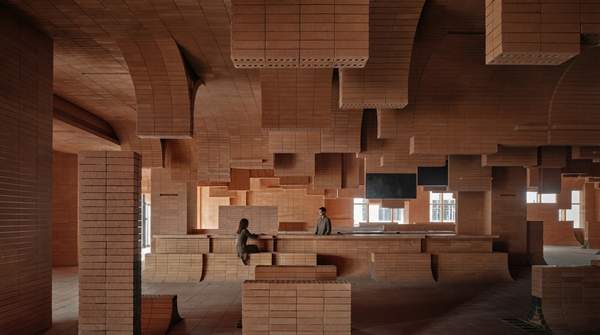
In Shanghai, Wutopia Lab completed a poetry bookstore inside the historic St. Nicholas Church, with a concept the firm calls "Church in church": a freestanding structure of 45 tons of steel that conforms to the building's domed interior. The steel shelving system holds 1,000 volumes of international poetry in multiple languages, which, per the architects' own project text, makes it the largest professional poetry bookstore in Shanghai. Wutopia Lab describes its design style as "magical realism based on antithesis," citing perforated steel plates, translucent and "uncertain" light, and "dramatic poetry" as the store's defining qualities. The project credits list Yu Ting as chief architect, with Chloe Zhang as light consultant. The atmosphere the firm reaches for is a contemplative one—the poetic sensibility is echoed in the epigraph the project materials carry: "Poetry is connate with the origin of man."
Kids Winshare: Playful Pathways for Young Readers
Where Sinan Books pursues reverence, Kids Winshare in Chengdu pursues joy. Designed by Panorama Design Group, the children's bookstore guides young visitors through blue archways that open into themed zones—including a baking classroom with butter-yellow walls and custom furnishings. The palette is bright, the forms are whimsical, and the architecture itself behaves like a picture book: each archway is a page-turn into a new scene. The design's logic is to make books one delight among many, embedding reading within an environment of play. It is a bookstore aimed squarely at stimulating young minds, where the built environment works to lower the threshold for a child's first independent wander through the stacks.
Comparative Design Strategies of Inspiring Bookstores
To see how differently these firms deploy the same raw materials, the table below sorts each bookstore along three analytical axes: the key design feature, the dominant aesthetic, and the resulting atmosphere as described in the project documentation.
| Bookstore | Key Design Feature | Dominant Aesthetic | Resulting Atmosphere |
|---|---|---|---|
| Chongqing Zhongshuge (X+Living) | Fantasy-world interior by creative director Li Xiang; his eighth project for the client | Fantastical and illusionary | Immersive; draws shoppers into a unique experience of exploration |
| Sinan Books Poetry Store, Shanghai (Wutopia Lab) | 45-ton steel shelving system conforming to the church's domed interior; perforated steel plates and uncertain, translucent light | Monumental, reverent, "magical realism based on antithesis" | Quiet contemplation; a sanctuary for 1,000 volumes of poetry |
| Kids Winshare, Chengdu (Panorama Design Group) | Blue archways leading to themed zones, including a butter-yellow baking classroom | Bright, whimsical, colorful | Playful and stimulating; fosters wonder for young readers |
The comparison reveals the central insight: shelving and lighting, the two most quotidian elements of any bookstore, are precisely where these firms invest their ambition. One bends them toward fantasy, one toward the sacred, one toward play.
Crafting Immersion: Unconventional Shelving and Lighting
Across these projects, immersion is manufactured through the same two levers. In Xi'an, another Zhongshuge location designed by Wutopia Lab, recessed LEDs snake across the ceiling of the store—a ceiling-integrated lighting scheme that Interior Design pairs with its description of a "reader's paradise." In Shanghai, the Sinan Books shelving is not furniture but structure: 45 tons of formed steel, shaped to the dome, so that the containers for the poetry themselves create the sacred interior. The effect Wutopia Lab describes—translucent, uncertain light filtered through perforated steel—shows lighting doing atmospheric work that paint or decor cannot. And in Chongqing, X+Living constructs the shelves as part of a fantasy environment rather than as neutral storage. In each case, the architects treat shelving as sculpture and lighting as mood, which is what elevates a retail space into a destination.
Transforming Spaces: Actionable Insights for Bookstore Design
To create an inspiring and inviting bookstore, prioritize design elements that cultivate a distinct atmosphere aligned with the intended reader experience, whether it's fantastical exploration, poetic contemplation, or playful discovery. The lesson from these three projects is consistency of intent: X+Living commits entirely to wonder, Wutopia Lab to reverence, Panorama Design Group to fun, and none dilutes its concept with half-measures. A measurable indicator of success is increased positive feedback from visitors regarding the unique ambiance and immersive quality of the space, reflected in social media engagement or direct comments—the kind of attention these published projects have already drawn in the design press.
Sources
- Creative Spaces: 12 Stunning Library and Bookstore Designs — Interior Design
- Sinan Books Poetry Store / Wutopia Lab — ArchDaily