The short answer: if you want a clean, modern look for light décor, choose floating shelves; if you need to hold heavy books or cookware, choose bracketed shelves; if you simply want to lean framed photos against the wall, a picture ledge is the easiest option of all. Every wall-mounted shelf is a trade-off between how it looks, how much it can safely carry, and how hard it is to install—and the third factor matters more than most buyers realize, because a shelf's rated capacity means little if it isn't anchored into the right wall structure.
Choosing Your Wall Shelf: Floating, Bracketed, or Picture Ledge?
Three designs dominate decorative wall shelving, and they differ in one fundamental way: where the support lives. A floating shelf hides its brackets inside the shelf body, producing a seamless slab that appears to grow from the wall. A bracketed shelf wears its supports openly, with visible metal or wood arms carrying the load. A picture ledge is a shallow rail designed for one narrow job—displaying photos and small objects.
Comparative guides from home décor retailers consistently land on the same pattern. Floating shelves score highest on aesthetics but only moderately on weight capacity and demand the most precise installation. Bracketed shelves reverse that trade: they sacrifice the minimalist look for the highest load-bearing capability and the easiest mounting. Picture ledges sit at the light, simple end of the spectrum. A buying guide from Ashdeco rates floating shelves as medium-to-high capacity with moderate installation, bracket shelves as medium capacity and easy to install, and picture ledges as low capacity and easy to install—best suited to photos and small items.
Floating Shelves: Modern Aesthetics, Moderate Capacity
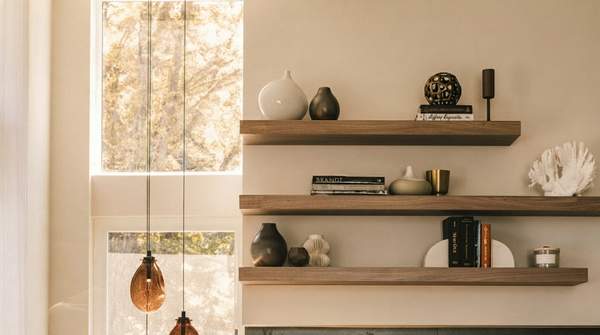
The appeal of a floating shelf is visual subtraction. With no visible hardware, the shelf seems to hover, which is why Woodsnap's comparison guide describes the look as "minimal, seamless, modern" and notes that these shelves visually declutter a room and put the emphasis on whatever sits on them. Nook Woodworking's comparison makes the same point from a spatial angle: a floating shelf makes a wall feel open and airy where brackets take up more visual space.
That elegance has a price, and it is paid at installation time. Because the brackets are hidden, everything depends on precise measurement and leveling; both Woodsnap and Nook Woodworking rate floating shelf installation as moderate to hard, harder than bracketed alternatives. Capacity is moderate too. Tara Garcia, writing for Spryinterior, puts a well-installed floating shelf at roughly 30 to 75 pounds, depending on construction and the anchors used, and notes that premium systems with internal steel brackets can significantly enhance support. Shelfology's engineering-focused guide is blunter: the hidden steel behind the shelf—and what it is fastened to—decides whether it holds 20 pounds or 400.
The practical conclusion across these sources is consistent: floating shelves are best for décor, plants, glassware, framed photos, and light storage. They are not the right choice for heavy books or dense items.
Bracketed Shelves: Robust Support, Visible Hardware
Bracketed shelves are the workhorses of wall-mounted storage. Their visible supports are not a flaw to hide but a design element in themselves—Woodsnap's guide notes the aesthetic range runs from rustic to industrial, with "huge variety via bracket design," while Nook Woodworking calls the look functional rather than seamless. If your room leans farmhouse, workshop, or loft, the brackets are part of the appeal.
The functional payoff is real. Spryinterior's comparison states that bracketed shelves use visible metal supports that add structural strength, making them typically the better choice for heavy-duty storage, while floating shelves suit lighter displays. Woodsnap rates bracketed capacity as high because brackets distribute the load effectively, and both guides list books, cookware, and heavy collections as the best use case. Among wall-mounted types, bracketed shelves generally offer the highest load-bearing capability.
Installation is also the most forgiving. Because the brackets are visible, alignment is easier and mistakes are simpler to correct; Woodsnap describes brackets as providing "stability and forgiveness," and Nook rates the process as easy and straightforward. Cost often favors brackets as well—standard bracket hardware is typically cheaper than the hidden systems floating shelves require.
Picture Ledges: Simple Display, Light Loads
The picture ledge is the specialist of the three. It is a shallow shelf whose whole purpose is displaying lightweight items—photographs, small prints, and modest decorative objects—often leaned rather than hung. Ashdeco's guide gives it the lowest weight rating of any wall-mounted type and the easiest installation, with minimal visible hardware and a modest price range of roughly $15 to $60.
That combination of subtle appearance and simple mounting is exactly the trade. A picture ledge asks almost nothing of your wall or your skill level, but it gives back very little capacity in return. It is not a shelf for books, plants in ceramic pots, or anything with real heft. Where it excels is the gallery-style display: a row of frames you can rearrange at will without putting a new nail in the wall each time.
The Critical Role of Wall Type and Mounting Hardware
Here is the point that overrides everything above: the actual weight a shelf can hold is determined less by its design than by what it is fastened to. Morgan Shaver, writing for Dogberry Collections, calls the anchoring surface the number-one factor, because the bracket is only as strong as what it is attached to. Wood studs offer the highest capacity—lag screws into studs can each hold 80 to 100 pounds in shear, and a shelf with four screws into two studs can realistically hold over 200 pounds. Masonry is also very strong with the right anchors. Toggle bolts in drywall between studs offer only moderate capacity, and the drywall itself can tear under sustained load.
Woodsnap's hardware guide quantifies the anchor ladder: plastic expansion anchors hold 10 to 25 pounds each and suit only light décor; self-drilling anchors manage 25 to 75 pounds; toggle bolts reach 70 to 200-plus pounds; strap toggles 100 to 250-plus pounds; and a direct stud mount tops the list at 100 to 300-plus pounds, limited only by stud spacing. The guide adds a physics warning worth remembering: even the strongest anchor can fail if the shelf projects too far from the wall or carries weight unevenly.
One more caution from Joybuy's buying guide: a shelf's stated maximum load usually applies only when the shelf is installed correctly and the weight is distributed evenly. Treat manufacturer ratings as conditional, and always follow the instructions for your specific product.
Shelf Selection Decision Matrix
The table below compares the three shelf types across the criteria that actually drive the decision. Read it against your own priorities: pick the row whose strengths match your primary need, and accept its stated weakness as the cost of that choice.
| Shelf Type | Aesthetics | Typical Weight Capacity | Installation Difficulty | Best For |
|---|---|---|---|---|
| Floating Shelf | Modern, minimal, seamless; no visible hardware | Moderate; roughly 30–75 lbs when well-installed, highly dependent on studs and anchors | Medium to complex; precise measurement and leveling required | Décor, plants, glassware, framed photos, light storage—not heavy books |
| Bracketed Shelf | Functional; rustic to industrial depending on bracket style; hardware is part of the design | High; brackets distribute load effectively—generally the highest among wall-mounted types | Easy; visible brackets are forgiving to align | Books, cookware, heavy collections, bulk storage |
| Picture Ledge | Minimal visual intrusion; shallow display rail | Low; rated for lightweight items only | Easy; simplest of the three | Photos, prints, and small decorative objects |
The pattern the matrix reveals is a clean three-way split: floating shelves buy aesthetics with installation effort and capped capacity; bracketed shelves buy strength and easy mounting at the cost of visible hardware; picture ledges buy simplicity at the cost of nearly all load-bearing ability. No single type wins on all four criteria, which is why the choice has to start with your own ranking of them.
Making Your Shelf Choice: A Practical Decision
Choose your wall shelf based on a clear understanding of the trade-offs between desired aesthetic, required weight capacity, and your comfort with installation complexity, always prioritizing secure mounting into appropriate wall structures. In practice: rank your three priorities, match them to the matrix above, and then check your wall before you buy anything—find your studs first, because a shelf that can't reach solid framing can't safely carry its rated load no matter how well it's designed.
The measurable indicator of success is simple: the reader successfully identifies their preferred shelf type and understands the necessary installation precautions before purchase. If you can name your type, state roughly what it will hold, and say whether your wall offers studs, masonry, or only drywall for anchoring, you are ready to shop with confidence.
Sources
- Floating Shelves Guide: Types, Sizing & Installation — Ashdeco
- Floating Shelves or Wall Mounted Shelves for Home — Woodsnap
- What’s the Difference between Floating Wall Mounted Shelves and Regula — Nook Woodworking
- Which of the shelves will support the greatest weight? — Spryinterior
- The Ultimate Guide to DIY Floating Shelves — Shelfology
- How Much Weight Can a Floating Shelf Hold? — Dogberrycollections
- The Ultimate Guide to Wall Shelf Hardware. — Woodsnap
- Wall Shelf Buying Guide: 7 Tips to Choose and Install — M