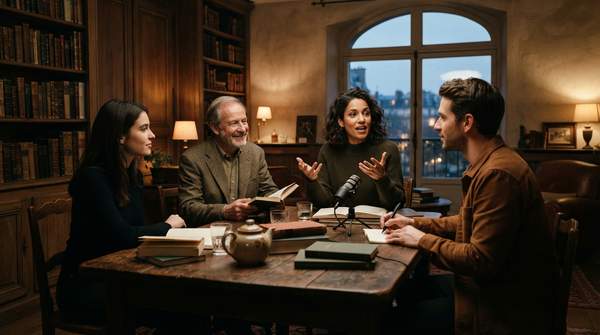
Literary salons began as intimate gatherings in 17th-century French homes, grew into engines of Enlightenment conversation, crossed into Britain and Ireland, and became 19th-century cultural institutions. Today, their core principles—curated company, a host who orchestrates rather than lectures, and an atmosphere that invites honest exchange—are being revived in podcasts, pop-culture events, and online communities. If you want to understand where this tradition came from, or how to build something like it yourself, the history offers a surprisingly practical blueprint.
The Enduring Appeal of the Literary Salon
What makes a salon different from a party is intention. It is a room assembled around conversation rather than spectacle, and its power has always come from who is in the room and how they are brought together. Contemporary accounts of salon culture are often dominated by idealistic notions of politeness, civility, and honesty, though historians debate whether the gatherings always lived up to those standards, as one survey of salon literature notes.
That tension is precisely why the format endures. The salon promises something rare: a semi-private space where ideas can be tested among people chosen for their capacity to contribute. Recent revivals suggest the promise still resonates. When the pop-culture podcast (UN)COVER GIRL staged an intimate salon for Los Angeles literati, co-host Ivana Rihter described the appeal plainly: "a salon feels like a liminal space where strangers turn into friends, it lights a fire in you to talk recklessly about whatever moves you."
From Italian Roots to French Refinement: The Birth of the Salon
The word "salon" first appeared in France in 1664, borrowed from the Italian salone, itself from sala, the large reception hall of Italian mansions. Earlier French literary gatherings were named for the rooms they happened in—cabinet, ruelle, alcôve—and before the end of the 17th century were frequently held in the bedroom, where a lady, reclining on her bed, received close friends seated on chairs and stools drawn around her.
The institution took its definitive shape with Catherine de Vivonne, Marquise de Rambouillet. Married at twelve and distanced from the royal court's vulgar intrigues by both her health and a desire for a more refined social environment, she made her home a celebrated center for literary and artistic discourse that prized sophistication and intellectual engagement over social rank. Her gatherings drew figures such as the playwright Pierre Corneille and founding members of the Académie Française, and she maintained them until her death in 1665.
The salon's influence reached into language itself. At the height of its fame, the French government under Cardinal Richelieu was standardizing a language splintered into dozens of dialects and pronunciations, and the refined conversation cultivated at the Hôtel de Rambouillet helped set the standard of natural, eloquent expression that the era's writers aspired to.
The Enlightenment's Intellectual Hubs
In the 18th century, the salon became what historians describe as an institution of Enlightenment. Under salonnières such as Madame Geoffrin, Mlle de Lespinasse, and Madame Necker, gatherings brought together Parisian society, the progressive philosophes producing the Encyclopédie, the Bluestockings, and other intellectuals to discuss topics ranging across the social, literary, and political questions of the day.
Women held powerful influence in this arrangement. As regulators, they selected their guests and decided the subjects of their meetings; as mediators, they directed the discussions themselves. Antoine Lilti, writing on eighteenth-century Parisian salons, situates these gatherings within a broader cosmopolitan Republic of Letters with a French—and even Parisian—center, though he notes that "Republic of Letters" was not itself a phrase central to the Enlightenment lexicon in France, where writers more often spoke of the philosophes and gens du monde.
A Timeline of Literary Salons: From Refinement to Revival
Tracing the salon era by era shows what changed and what stayed constant. Across three centuries, the format kept its reliance on a host's curation and conversation as the main event, while its social function shifted from refining manners, to circulating Enlightenment ideas, to sustaining cultural networks, to today's community-building.
| Era | Key Locations | Defining Characteristics & Function | Notable Figures/Salons |
|---|---|---|---|
| Early French Salons (17th century) | Paris, notably the Hôtel de Rambouillet; Italian precedents | Refinement of language, manners, and social discourse; sophistication prized over social rank; intimate gatherings in private rooms | Catherine de Vivonne; Pierre Corneille; Académie Française members |
| The Enlightenment Hub (18th century) | Paris | Institution of Enlightenment: interface between society, philosophes, and intellectuals; women as regulators and mediators of discussion | Madame Geoffrin, Mlle de Lespinasse, Madame Necker |
| British & Irish Expansion (long 18th century, c. 1750–1820s) | London and Ireland, with Anglo-Irish cultural transfer | Salons studied as a network across Britain, Ireland, and France; convivial political-literary gatherings | Holland House, hosted by the third Lord Holland and Lady Holland (1797–1840) |
| 19th-Century Cultural Centers | Paris and across Europe | Platforms for modern art, politics, and literature; spaces for voices excluded elsewhere, including women | Gertrude Stein's Paris salon (Picasso, Hemingway, Fitzgerald) |
| Modern Revival (21st century) | Los Angeles; online communities | Salon principles applied to pop culture and digital community-building; privacy enables freer criticism and welcomes women | (UN)COVER GIRL's "Under the Covers"; Eli Rallo's Prose Hoes |
Across the Channel: British and Irish Adaptations
The salon was never exclusively French. Amy Prendergast's study of literary salons across Britain and Ireland in the long eighteenth century focuses on the period between 1750 and the 1820s, examining Irish salon culture in the wider context of contemporary Britain and France—including the "cultural transfers" between them, often viewed through the eyes of Irish travellers, exiles, and those of dual Anglo-Irish nationality.
In London, the most storied example was Holland House. Beginning in the mid-eighteenth century with Henry Fox, first Lord Holland, as a convivial Whig gathering place, it became—under the third Lord Holland and his wife, who entered the salonnière ranks through that marriage—"a powerful cultural and political center between 1797 and 1840" and one of London's chief cultural hubs, attracting both literary and political grandees.
19th-Century Salons: Cultural Centers and New Voices
By the 19th and early 20th centuries, the salon had become a fixture of European cultural life rather than a French peculiarity. The most famous example, at least in popular imagination, is Gertrude Stein's small Parisian apartment, where the era's best and brightest gathered to philosophize about modern art, politics, and literature, with attendees including Pablo Picasso, Ernest Hemingway, and F. Scott Fitzgerald.
Just as significant, if less mythologized, is what salons offered people excluded from other cultural outings. Reporting on contemporary online revivals notes that the privacy of salon spaces historically meant people were free to criticize the government and that salons were a welcoming environment for women who could be excluded from other cultural venues. The salon's social function—giving the excluded a room of their own, in company—proved as durable as its intellectual one.
Reviving the Salon: Principles for Modern Intellectual Community
The historical record translates into a workable framework. Three principles recur across four centuries of salon practice, and you can apply them whether you are hosting a dinner, a studio night, or a monthly book gathering.
- Curate the guest list for cross-pollination. The salonnière's first question, as one modern guide to hosting in the salon spirit puts it, is "Who needs to be in the room? Not just the obvious experts, but the unexpected voices that spark cross-pollination." Ranks and credentials mattered less at Rambouillet than capacity for conversation; your guest list should follow the same logic.
- Act as orchestrator, not lecturer. Enlightenment salonnières selected guests, set subjects, and mediated discussion rather than delivering monologues. The same guide describes the host's art as "orchestration — ensuring no one dominated, and everyone left changed."
- Create an atmosphere for intimate conversation. "Salons weren't lectures; they were intimate, playful, and conversational," the same account advises, asking hosts to consider what atmosphere will unlock sharing. The privacy of the historical salon is what made honest criticism possible; a modern gathering needs its equivalent, whether that is a small room, a closed online space, or a clear norm of discretion.
Contemporary examples show the framework flexing to new media. When Eli Rallo launched her literary salon Prose Hoes on January 10, describing it as "a literary salon for thought daughters," the announcement drew little media attention but nearly 14,800 Instagram followers in under a week. (UN)COVER GIRL's "Under the Covers" event assigned attendees a magazine cover story to explore, treating pop culture in a literary way—proof the format absorbs new subject matter without losing its shape.
Fostering Modern Intellectual Communities
Readers can actively participate in or initiate modern literary gatherings by applying the core principles of historical salons, focusing on curated conversation and a welcoming atmosphere. You do not need a hôtel in Paris or a title; you need a room, a considered guest list, a host willing to orchestrate rather than dominate, and the intimacy that lets people speak honestly.
The measurable sign of success is the same one the historical record supplies: increased mention or establishment of new salon-inspired communities and literary gatherings, both online and in-person. Prose Hoes' jump to roughly 14,800 followers within a week of launch, and a hotel penthouse hosting a podcast salon, are early instances of exactly that indicator. Watch for it in your own circle—one recurring gathering, built on these principles, is the tradition's next chapter.
Sources
- A Brief History of Salons - The Salon Host
- Literary Salons Across Britain and Ireland in the Long Eighteenth Century — Recensio
- BRITISH LITERARY SALONS OF THE LATE EIGHTEENTH AND EARLY NINETEENTH CENTURIES by… — Review19
- How Literary Salons Made a Comeback — Wildflower Cases
- How Literary Salons & Celebrity Book Clubs are Returning in the Age… — Gut Instinct Media
- The Kingdom of Politesse: Salons and the Republic of Letters in Eighteenth-Century Paris — SHC
- Salon (gathering) - Wikipedia — EN
- Catherine de Vivonne, Marquise de Rambouillet | History | Research Starters — EBSCO
- The Blue Room: Madame de Rambouillet’s Literary Salon — Bonjour Paris
- History of the Salon — Brooklyn Literary Salon
- The Radical Act of Gathering in a Lonely Age — Theladyofthechateau