Yes, damask belongs in a modern home — but only if you choose it deliberately. The fabric that once graced hand-loomed silk in imperial China works beautifully in a contemporary living room when you make three decisions in order: where it will live, what it must withstand, and how loud it should speak. Get those right, and damask reads as textured sophistication. Get them wrong, and it reads as a period costume. Here is how I'd make the call.
Understanding Damask: History and Defining Characteristics
Damask is defined by its construction, not by any particular motif. The pattern emerges from the weave itself — contrasting satin and plain or twill weaves shift the sheen across the surface, producing a tone-on-tone effect with subtle texture and depth. That sheen shift, rather than a change in color, is what gives damask its characteristic glow and visual richness. It is a woven structure, which distinguishes true damask from any printed imitation of the look.
The technique has serious pedigree. Regions of China specialized in this weaving long before it acquired the name, and early damasks were woven on hand-looms as rich, heavy fabrics of the finest silks and linen. These were not always the monochrome textiles we picture today: historical pieces carried two or even multiple contrasting colors, sometimes with metal and gold threads woven in for exclusivity. Writing on historic pattern styles, Bärbel Dressler notes that these textiles often featured botanical and animal motifs — living symbols of wealth and refinement.
Traditional vs. Modern Damask: Evolving Aesthetics
Style-wise, damask splits cleanly into two categories: traditional and contemporary. Traditional damask carries the classic motifs — botanicals, flowers, scrolled leaves, fruits, and animals — arranged with the symmetry that made the pattern a fixture of formal interiors for centuries. Its continuing popularity rests on that versatility; this is a style that has survived century after century precisely because it adapts.
Contemporary designers push it further while keeping its core identity intact. Scale manipulation is the most common modern move: oversized damask, with the repeat blown up to 24 inches or more, transforms a traditional pattern into a bold, contemporary statement. Geometric interpretations offer another path away from the scrolled-leaf look. Meanwhile, the underlying ogee framework — a continuous lattice that extends across any surface — makes damask inherently suited to large-scale applications, because the pattern can cover extensive areas without interruption. That structural fact matters more than any trend cycle.
Damask in Upholstery: Balancing Style and Durability
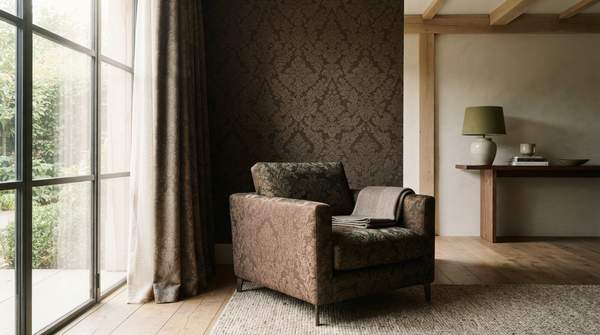
Upholstery is where damask earns its keep. The fabric is prized for furniture projects thanks to its attractive aesthetic and soft hand feel, and textile writers describe it as a tough, sturdy material that has been used for centuries in sophisticated upholstery. Damask upholstery in silk, cotton, or linen blends remains the standard for formal seating — the weave's durability and decorative effect working together rather than trading off.
For a high-traffic sofa, the logic follows the fiber and the weight. Damask is available in materials ranging from traditional silks and linen to modern cotton, polyester, and blends, and that range is what expands its suitability: a sturdy, heavy-weave damask suits furniture that must absorb daily use, while finer weaves belong on pieces that are touched more than tested. Retailers that organize home-decor fabric by use, fiber, and weight make this comparison practical — browsing by weight in particular tells you quickly whether a given damask is built for a family-room armchair or an occasional dining chair. And because the weave produces the pattern rather than printing it, the design won't sit on the surface where wear shows first.
Damask for Drapery and Wall Coverings: Light, Texture, and Impact
On walls and windows, damask behaves differently than any multicolored print, and that difference is the whole argument for using it. The tone-on-tone quality makes damask particularly effective as wallpaper: it adds visual richness and texture without competing with other elements in the room, receding gracefully into an elegant backdrop rather than demanding attention. A statement wall wants the opposite treatment — this is exactly where an oversized repeat, blown up to 24 inches or more, turns the same weave into a bold contemporary gesture.
Drapery plays to damask's formal character. Elegant drapes are among the fabric's classic uses, and the same weight that gives upholstery damask its sturdiness gives curtains their drape and body. Cushions, throws, and table linens extend the family: damask can be sewn into eye-catching accents throughout a room. The discipline is in the mix — one woven, tone-on-tone damask element anchors a scheme; three competing patterns undo it.
Damask Fabric Selection Framework for Home Decor
Use this matrix to move from your project to a fabric and scale. Read your application first, then let the recommended combination of material and pattern scale point you toward the right damask.
| Application | Best-Fit Material | Pattern Scale & Style | Key Consideration |
|---|---|---|---|
| High-traffic upholstery (family sofa, armchairs) | Cotton, polyester, or sturdy blends; heavy-weave damask | Traditional motifs at moderate repeat, or geometric interpretation | Durability — woven pattern won't wear off the surface; soft hand feel |
| Formal seating (dining chairs, occasional pieces) | Silk, cotton, or linen blends — the classic formal seating standard | Traditional botanical and scrollwork motifs | Refined aesthetic; less wear exposure justifies finer fibers |
| Formal drapery (dining room, living room curtains) | Weighty damask with good drape, chosen by fabric weight | Traditional or moderate contemporary repeat | Light interaction and body; elegance over hardiness |
| Wall covering, elegant backdrop | Wallpaper-format damask with tone-on-tone weave effect | Continuous ogee lattice, moderate scale | Recedes gracefully; adds texture without competing with the room |
| Statement wall, contemporary look | Wallpaper or upholstery-weight damask | Oversized repeat — 24 inches or more — or geometric interpretation | Visual impact; the blown-up scale is what reads as modern |
| Decorative accents (cushions, throws, table linens) | Any damask fiber suited to the use | Small to moderate repeat | Eye-catching accents; keep the rest of the scheme restrained |
The reasoning path is consistent: the woven construction gives you durability and tone-on-tone depth on any budget of fiber; the fiber and weight determine whether the fabric survives a high-traffic sofa or drapes formally; and the repeat size sets the aesthetic register — traditional at moderate scale, contemporary when oversized.
Making Your Damask Choice: A Confident Decision
You can confidently select and integrate damask into modern decor by matching its inherent characteristics — weave, material, and pattern scale — to your specific application, desired aesthetic, and functional requirements. That means a heavy-weave cotton or blend with a moderate repeat for the sofa, a linen-blend damask with classic scrollwork for formal dining chairs, and an oversized tone-on-tone repeat on one wall when you want the room's boldest gesture.
The measurable indicator of success is simple: you identify a damask fabric and pattern that aligns with your project's needs and aesthetic vision, leading to a purchase or design plan — a specific fabric, fiber, and repeat size you can name before you buy. Skip the printed imitations, respect the weight for the job, and let the weave do what it has done for centuries: make a room richer without shouting.
Sources
- Damask Patterns: History, Characteristics, and Modern Applications — Pattern Weaver
- What Are Damask and Jacquard Fabrics? — KOVI Fabrics Blog
- Historic Pattern Styles: The Damask — Historyrepeating
- What is damask? Guide to uses, qualities, and buying tips — fabric fabric