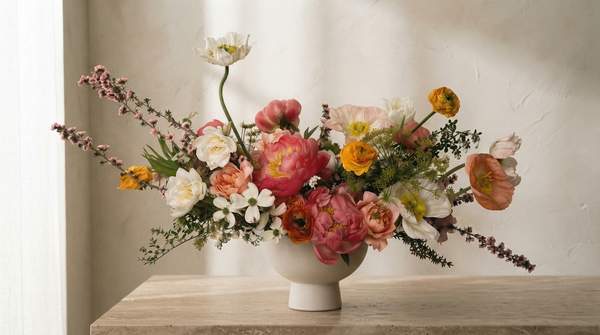
The secret to a striking floral arrangement rarely lies in the flowers alone — it starts with the vessel. A cherry branch that flops in a slim bottle stands sculptural in an urn; a single ranunculus that disappears in a wide bowl becomes a quiet statement in a bud vase. This guide compares five essential decorative vase types — urn and hourglass, bud, fishbowl, cylinder, and trumpet — so you can match each shape to your flowers and your interior, and know exactly why the pairing works.
Core Principles for Pairing Vases with Flowers
Three practical principles govern nearly every successful pairing: proportion, support, and weight. Stylist Arlyn Hernandez, writing for Emily Henderson's design blog, makes the case plainly: the bulbous body of an urn or hourglass vase, set against a smaller opening, is "a great vehicle for letting stems spread out inside the vase for a good lean outside of the vase." In other words, the geometry inside the vessel dictates the silhouette you see above the rim.
Support follows from weight. If you love hefty branches, Hernandez advises, "make sure the vase is heavy enough to support the weight of the extension of the branches." A tall, dramatic armful of blossoms acts like a lever on the vase; a bottom-heavy ceramic or glass body keeps the composition anchored rather than tipping.
Finally, consider what each opening does. A narrow neck gathers stems into a tight, tidy column; a wide mouth lets blooms spread and breathe. The same source notes that a single-flower bouquet in a fishbowl can look "tidy, modern, and easy," precisely because the vessel constrains the arrangement's character. Choose the opening for the effect you want, not just for the flowers you bought.
Five Essential Decorative Vase Types and Their Uses
Each of these five forms solves a different floral problem. The urn and hourglass vase pairs a wide, rounded body with a narrower mouth — ideal for large, wild groupings of flowers or branches, and for varied arrangements mixing standing varieties with floppy ones (think eucalyptus against hydrangeas). Hernandez particularly values these forms for inflexible varieties like cherry blossoms, whose stems need room to lean and spread, and notes they look beautiful at the center of a dining table, on a credenza, or on a kitchen island.
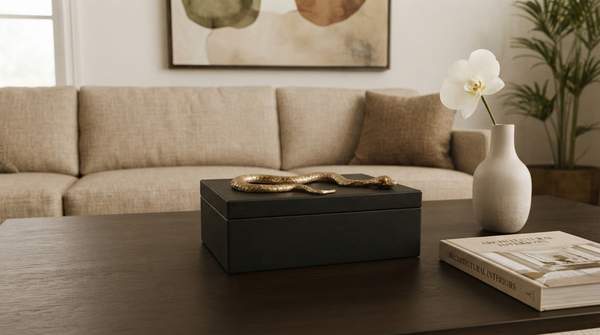
The bud vase is its opposite in scale: small, with an opening sized for single stems and clippings. Hernandez reaches for bud vases with small flowers like ranunculus, a clipping of lilac, pansies, or billy balls — anything that reads as a single, deliberate gesture rather than a bouquet.
The fishbowl sits between the two. It excels with heavy-headed flowers such as peonies, hydrangeas, roses, and mums, cut fairly short so the bloom — not the greenery — is the star. Any flower without too much flop works here, according to the same stylist's account.
The cylinder vase offers a clean, linear structure whose understated elegance lets floral textures and bloom color remain the focal point, according to guidance from Edward Martin. The trumpet vase, by contrast, flares gradually outward, so flowers spread with a softer, fuller appearance while stems stay supported at the center. That widened aperture suits abundant-petaled flowers — peonies, dahlias, carnations, garden roses — because it prevents bloom compression and preserves petal structure, and its elevated profile adds verticality for a more refined presentation.