The Bauhaus and the Wassily Chair: Industrial Innovation Meets Art
A century later, a very different institution asked a very similar question. The Bauhaus, founded by Walter Gropius in Weimar in 1919, began with an artisanal focus—Gropius's initial aim, as the Metropolitan Museum of Art explains, was a unification of the arts through craft. But that approach proved financially impractical, and in 1923 Gropius repositioned the school's goals toward designing for mass production, adopting the slogan "Art into Industry." After the move to Dessau in 1925, the Bauhaus-Archiv records, the school's workshops increasingly collaborated with industry under the guiding principle "Art and technology – a new unity," producing models of furniture, lamps, and textiles suitable for serial production.
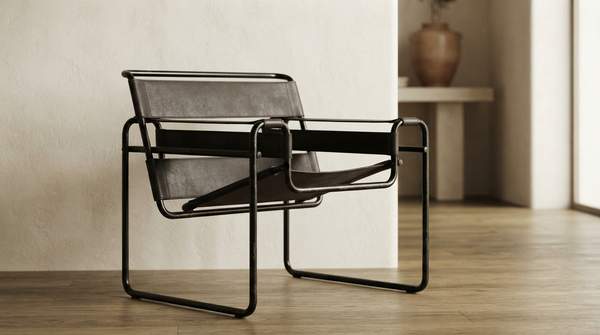
Marcel Breuer's Wassily Chair is perhaps the most famous object to emerge from this shift. As the Metropolitan Museum describes, Breuer was inspired by the extruded steel tubes of his bicycle and experimented with metal furniture, ultimately creating lightweight, mass-producible metal chairs. Knoll, which produces the chair today, explains that the design drew on the principle that strength and flexibility could coexist, challenging traditional ideas about the heaviness and bulk of lounge chairs. The chair's bent tubular steel frame carries leather, canvas, or hide slings in tension—clean joints, precise bends, and taut seat and back surfaces, in Knoll's description of the design details.
The chair's very name reflects the school's cross-disciplinary spirit: Knoll recounts that Breuer's Bauhaus colleague Wassily Kandinsky, the abstract art pioneer, was so taken with the prototype that Breuer crafted an additional chair for him, and the design was later named in his honor. Wikipedia's Bauhaus entry identifies the Wassily Chair, alongside the cantilever chair, as one of the school's most important contributions to modern furniture design.
The Bauhaus context shaped the chair's logic. As the design outlet Pragmatika observes of the era's interiors, furniture became light, serial, and free of unnecessary decoration, with its form dictated by the conditions of production and operation. Where the Shaker chair was shaped by hand tools and belief, the Wassily Chair was shaped by factory processes and a school determined to unite art with technology.