The right choice comes down to three questions: what you're displaying, how much weight it carries, and how permanent you want the installation to be. Floating shelves offer the cleanest look and the highest capacity, but they demand drilling into studs. Picture ledges are the natural home for rotating framed art but are rated for light loads. Ladder shelves ask nothing of your walls at all—they lean in place and trade floor space for zero damage, which makes them the strongest option for renters.
Introduction to Decorative Wall Shelving
Wall shelving has quietly become one of the most contested decisions in a design-conscious home, because the shelf is never just storage—it is the stage. Thin floating shelves have become a popular way to show off collectibles, as retailers like The Shelving Store note, particularly in smaller living spaces where a full cabinet would hog the floor. But the terms get muddy fast: "picture ledge" and "floating wall shelf" are often used interchangeably, even though they describe meaningfully different products with different limits.
The three systems compared here occupy distinct positions. A floating shelf mounts invisibly to the wall and disappears behind what it holds. A picture ledge is its thinner, lighter cousin, built for framed pieces rather than heavy objects. A ladder shelf, as Ashdeco's buying guide puts it, simply leans against the wall, giving a tiered display with no drilling at all. Each answers a different household need.
Understanding Each Shelving System
Floating shelves are flat from front to back with no lip, held tight against the wall by hidden metal rods or a cleat so the hardware is invisible once installed—the source of their clean, modern look. Their flat depth is what makes them versatile: as Home Wall Trends explains, the surface has room for three-dimensional items like ceramic pots and stacked books that would never balance on a narrow ledge. Common materials include hardwoods, plastic, and metal, with wood and metal being the most durable and least likely to bend or break, according to Architectural Digest.
Picture ledges are the thin end of the family. IKEA rates its roughly 45-inch MOSSLANDA ledge at just 16.5 lb—enough, as the same guide observes, for a row of frames but not for books. That constraint is the point: ledges are designed for lightweight displays, especially framed photos and small art that benefit from being propped rather than hung.
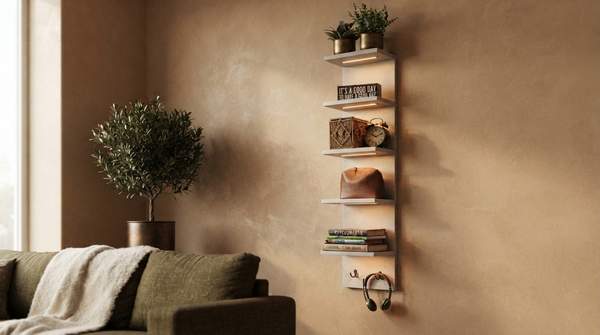
Ladder shelves are freestanding units that lean against the wall, no drilling needed. Ashdeco's guide notes they deliver the same tiered display as staggered floating shelves but with zero wall contact, and that solid wood options can look just as good as wall-mounted versions. The trade is floor footprint: unlike the other two, a ladder shelf occupies the room itself.
Shelving System Comparison: Floating, Picture Ledge, and Ladder
The table below compares all three systems across the six factors that actually drive the decision: how they install, how much they hold, what they're best for, how they look, what they cost you in floor space, and how forgiving they are if you rent or like to change your mind. The verdicts in the final column follow directly from those rows—heavy books need stud-mounted floating shelves, rotating art needs ledges, and no-drill situations need a ladder.
| Decision Factor | Floating Shelf | Picture Ledge | Ladder Shelf |
|---|---|---|---|
| Installation Method | Drilling into studs or heavy-duty anchors; hidden rods or cleat | Drilling required, but easy; minimal visible hardware | Freestanding; leans against the wall, no drilling |
| Weight Capacity | Medium to high—budget models commonly rated 15–35 lb; heavy-duty units in studs rated roughly 100–300 lb by makers | Low—one popular 45-inch IKEA ledge is rated 16.5 lb | Medium; varies by design and material, so check product specs |
| Best Use Case | Books, ceramic pots, three-dimensional objects on a stable flat surface | Framed photos and small art you like to rearrange often | Books and decor where walls must stay intact |
| Aesthetic Profile | Clean, modern, minimalist—hardware invisible once installed | Gallery-style; keeps a changeable wall of art | Tiered, staggered display; solid wood options rival wall-mounted looks |
| Floor Space Impact | None | None | Yes—takes a floor footprint like any freestanding piece |
| Rental Friendliness | Low—Ashdeco notes there is no no-drill alternative that achieves the same look | Low—requires drilling, though lighter loads make install easier | High—no holes, no damage, fully removable |
Two qualifications matter. Capacity ratings only hold when the shelf is screwed into studs; one mounted on plastic anchors in drywall often cannot reach its rating, and Home Wall Trends warns a heavy plant on weak anchors can pull straight out of the wall. And every figure here is a general estimate—manufacturer instructions govern any product you actually buy.
Choosing the Right Shelf for Your Home
For a heavy book collection: choose floating shelves mounted into studs. Heavy-duty versions are rated roughly 100 to 300 lb by their makers, and the flat surface holds stacked books and ceramic objects that a narrow ledge cannot. Architectural Digest's roundup illustrates the realistic spread: one shelf rated at 30 lb when installed into a stud, another rated at 150 lb with a mounting strip and screws. Check the specific rating before loading it with coffee-table books.
For a changeable gallery wall: choose picture ledges. Their purpose is art without commitment—if you like to change art often, a picture ledge saves a lot of patching, as Home Wall Trends puts it. The weight math is forgiving in that role: framed pieces are light, with a typical 8x10 frame weighing about a pound and a 16x20 frame with glass perhaps three, per Shelf Expression. Rows of photos sit happily within a ledge's modest rating; books do not.
For a rental or no-drill situation: choose a ladder shelf. It delivers the tiered display effect with zero wall contact, and can be moved out as easily as it moved in. If you're set on the true floating look anyway, know that it cannot be achieved without wall mounting, so a ladder shelf or similar freestanding piece is the honest alternative.
Making Your Choice: Matching Shelves to Your Home
Homeowners should select a shelving system based on their primary display needs, desired aesthetic, and willingness to undertake permanent installation. The framework reduces to one sentence: heavy items and a minimal look justify drilling; light, rotating art justifies a ledge; intact walls justify a footprint on the floor. Where your household has children, Ashdeco adds sensible caution—install correctly, use heavier-duty anchors than the minimum, and keep heavy or fragile items on higher shelves out of reach.
You'll know the choice is right when the chosen shelving system is successfully installed and effectively displays items without compromising structural integrity or aesthetic goals. That is the measurable test: a shelf that reaches its rated capacity because it's anchored in studs, a ledge that lets you swap art without touching a drill, or a ladder shelf that leaves the wall behind it unmarked when you move on.
Sources
- The Difference Between Picture Ledges & Floating Wall Shelves — The Shelving Store
- Floating Shelves Guide: Types, Sizing & Installation — Ashdeco
- Floating Shelves vs Picture Ledges: Which Is Best? — Home Wall Trends
- The Best Floating Shelves Create Endless Storage Opportunities — Architectural Digest
- Floating Picture Shelves: How to Display Photos Without Destroying Your Walls — Shelf Expression