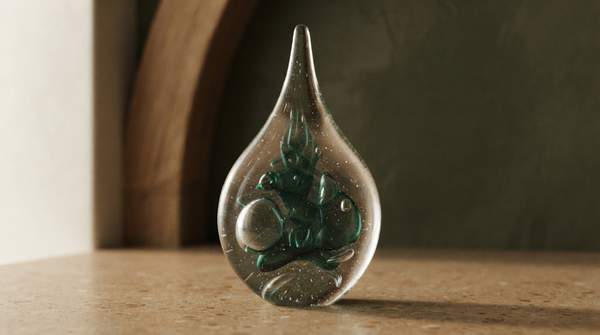
Authentic hand-blown glass announces itself quietly. Look for subtle asymmetry, variations in wall thickness, optical distortions or ripple lines across the surface, and small air bubbles trapped within the material. These are not flaws to apologize for; they are the physical residue of a human being shaping molten glass with a blowpipe and hand tools. Machine-molded glass, by contrast, aims for uniformity, and its near-perfect evenness is the clearest signal that no artisan was involved. Learning to read these markers turns a vague sense of "character" into a concrete evaluation you can perform on any piece of glassware before you buy it.
Your Checklist for Identifying Hand-Blown Glass
Artisan and studio sources converge on a consistent set of observable signs. The materials guide from LES VRAIS, a design distributor of handmade glass, describes how hand-blown pieces carry optical distortions on the surface and small bubbles created during the melting process, when air becomes trapped within the liquid glass. Glassblower Ben, an artisan writing on his own craft, adds that hand-blown pieces show slight asymmetry and variations in thickness compared with their machine-made counterparts.
Used together, these signs form a systematic screen. Hold the piece up to a light source and rotate it slowly. Watch how the light behaves as it passes through the walls, and run your fingers along the surface to feel for texture. The checklist below organizes each characteristic, what it looks like, and where it comes from in the making process.
Hand-Blown Glass Identification Checklist
To evaluate any piece of glassware, work through each row in turn. A piece that shows several of these markers—especially in combination—is very likely hand-blown; a piece that shows none, with perfectly even walls and a flawless, uniform surface, is more likely machine-molded. Note that the prominence of these features varies between pieces and artisans, so absence of one marker alone is not conclusive.
| Characteristic | What to Look For | Process Origin | Qualification |
|---|---|---|---|
| Subtle asymmetry | Slight irregularity in shape; the piece is not perfectly round or even when rotated | Free-form shaping by hand rather than a mold | Should be subtle; gross distortion may indicate damage rather than craft |
| Variations in thickness | Walls that are measurably or visibly thicker in some areas than others | Manual control of the molten gather during blowing | Prominence varies between pieces and artisans |
| Optical distortions | Ripple lines or distortions visible on the surface, playing with transmitted light | Hand-shaping of the surface during blowing | An integral part of the material's charm, per artisan descriptions |
| Trapped air bubbles | Small bubbles suspended within the glass body | Air trapped within the liquid glass during melting and blowing | A natural occurrence of the process, not a defect |
| Unique texture and feel | Tactile irregularity; reflections and mirroring effects that shift across the surface | Bubbles and surface distortions interacting with light | Each piece differs; no two will feel identical |