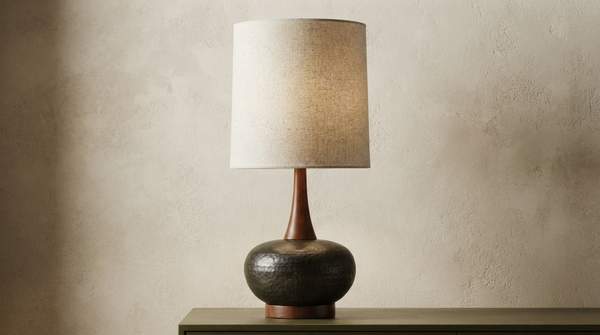
Mid-century modern lighting is defined by a compact set of traits: clean lines and simple forms, a functional purpose that outranks ornament, a palette of both natural and newly industrial materials, and streamlined, often geometric silhouettes. If you can read a fixture across those three dimensions—principle, material, and form—you can recognize the style with confidence. I'll walk through why those traits exist, then assemble them into a working identification framework you can apply to any lamp or fixture you encounter.
Defining the Style and Its Historical Roots
Mid-century modern broadly describes the architecture, furniture, and product design that emerged around the middle of the 20th century, particularly from the 1940s through the 1960s. As lighting maker Anglepoise explains, the style's origins trace back to early modernist movements like the Bauhaus, where designers focused on simpler forms, new materials, and industrial production, rejecting excessive ornamentation.
Following the Second World War, these concepts evolved distinctly in Europe and America. Designers including Charles and Ray Eames, Hans Wegner, Robin and Lucienne Day, and Gio Ponti explored new approaches to everyday objects, while advances in manufacturing made good design increasingly accessible. In Britain, the 1951 Festival of Britain helped introduce a more optimistic, contemporary approach to interiors to a wider audience. The period had no single look, but it became associated with practical forms, honest materials, and objects designed around how people actually lived. Visa Lighting notes the style is closely associated with the postwar era through the 1960s, and vintage guides often date authentic era pieces to roughly 1945–1970.
Core Design Principles
Three principles anchor the aesthetic. First, simplicity: clean lines and uncluttered silhouettes that prioritize visual clarity. Second, functionalism—many of the best mid-century designs were created first and foremost to be useful, and that balance between appearance and purpose is central to the style. Third, material honesty and innovation: designers embraced both natural materials and newly fabricated ones rather than disguising them.
Function often shows up physically in the fixture itself. Sleek, streamlined forms frequently come with adjustable features, such as adjustable arms or swiveling shades, which Visa Lighting points to as hallmarks of the style. A lamp that visibly articulates—bends, swivels, redirects—is expressing the era's conviction that a design should serve the person using it.
Characteristic Materials
The material palette bridges the natural and the industrial. On the metal side, brass remains one of the most recognizable finishes associated with the style, alongside chrome; vintage-era pieces commonly feature brass or chrome finishes over clean geometric lines. Sleek metals provide durability and a modern finish that suits the style's restrained silhouettes.
Wood supplies the warmth. Teak and walnut are the period's signature timbers, and floor lamp bases often use organic materials like natural oak or waxed wood, sometimes chunky, sometimes sleek and minimal. Finally, glass, Lucite, and fiberglass appear in diffusers and shades, allowing varied light diffusion and sculptural forms. Design writer Joshua Jones of JJones Design Co. summarizes the formula: warm, natural materials paired with clean, simple forms.
Iconic Forms and Silhouettes
Certain shapes recur so often they function as style signatures. The tripod floor lamp—three legs, typically topped with a simple, understated shade—is one of the most recognizable, with bases ranging from slender and minimal to chunky and organic. The orb or globe form appears as a tall, minimalist stem topped with a circular globe, a shape loved for its simplicity and the generous light it brings to a room.
Beyond those, expect streamlined, geometric silhouettes: bold shapes, curves, and sometimes unusual proportions. A tapered column floor lamp, for instance, starts larger at the base and gently narrows toward the shade. New fixtures in the style typically carry a retro aesthetic evoking the 1950s and 1960s. Anglepoise cautions that there is no single formula—some designs are architectural and restrained, while others embrace bold color and curves.
Identifying Mid-Century Modern Lighting: A Core Framework
Here is the three-part framework in one place. To analyze a fixture, evaluate it down each column and ask how the abstract principles show up concretely in its materials and shape.
| Dimension | What to Look For | Why It Matters |
|---|---|---|
| Design Principle | Clean lines and simple forms; functionalism over ornament, often with adjustable arms or swiveling shades | Prioritizes visual clarity; designs serve a practical purpose first |
| Design Principle | Honest, innovative use of both natural and newly fabricated materials | Reflects the era's experimentation rather than disguised construction |
| Material | Brass, chrome, and other sleek metals; teak, walnut, and natural oak woods | Metals give a sleek, modern finish; wood adds warmth and an organic touch |
| Material | Glass, Lucite, and fiberglass for diffusers and shades | Enables varied light diffusion and sculptural forms |
| Form/Shape | Streamlined, geometric, sculptural silhouettes—tripod bases, orb and globe forms, tapered columns | Bold, visually distinct shapes are the style's most recognizable cues |
Use it this way: a fixture need not check every box, but alignment across all three dimensions—useful form, period materials, and a signature silhouette—is what separates genuine mid-century character from generic retro styling. A chrome-and-Lucite orb pendant scores on material and form; a carved, heavily ornamented brass lamp with the same globe shade fails on principle.
Making Informed Decor Choices
When selecting lighting, homeowners can confidently identify mid-century modern pieces by evaluating their adherence to clean lines, functional design, characteristic materials, and geometric forms. One reassuring note from Anglepoise: modernist decor need not mean faithfully recreating a 1950s or 1960s interior. A few strong pieces of mid-century lighting can bring modernist character to a room while contemporary furniture and personal objects keep the space from feeling like a period set. Vintage guides make the same point from the other direction, arguing these fixtures complement contemporary interiors because their principles—clean lines, functional beauty—align with modern aesthetics.
A word on scope: this framework covers design characteristics, not wiring or safety, and not authenticating vintage pieces. The measurable test of whether it worked is simple: the homeowner can articulate the specific mid-century modern principles, materials, and forms present in a chosen fixture. If you can name why a piece qualifies—its functional silhouette, its brass-and-walnut construction, its tripod geometry—you have recognized the style on its own terms.