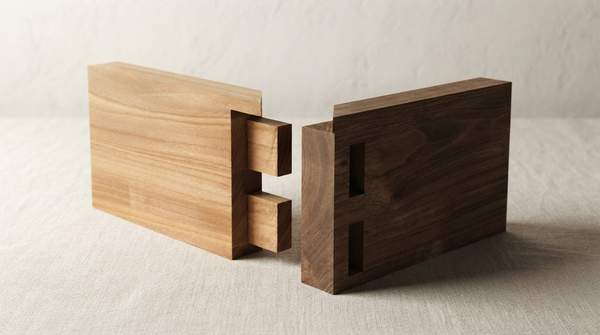
Traditional Japanese woodworking joints hold together by geometry, not hardware. Cuts decide where each piece stops; the tight fit of tenon in mortise or dovetail in housing keeps it there; and where pieces could still pull apart, a hardwood wedge, key or pin driven in last locks them. That is the account given by the design-and-build studio of architect Hitoshi Sato, whose illustrated guide to five joints distinguishes the two great families of Japanese joinery: shiguchi for members that meet at an angle, and tsugite for timbers spliced end to end. Understanding that distinction—and the locking logic behind each joint—is the key to appreciating both the craft's engineering and its quiet influence on furniture made today.
Core Principles: Strength, Movement, and Beauty
Japanese joinery begins with an honest material problem: wood moves. It expands and contracts with humidity, and a rigid connection that ignores this will fight the material until something fails. According to the toolmaker KAKURI's guide, written by Syoko Nozaki, a well-made Japanese joint allows for this natural expansion and contraction while the two pieces of wood fit together with no gaps. The joint works with the wood rather than pinning it down.
The second principle is the absence of metal fasteners. No nails or screws means the finished surface stays clean and uncluttered—and nothing can rust. This is not merely a stylistic preference. A nail creates a concentrated point of stress and a path for moisture; an interlocking wooden joint distributes load through the grain itself. The Sato studio's explanation is blunt: the joints hold "mostly by geometry." Position, retention, and locking are three separate jobs, each solved by a different cut.
The third principle is harder to measure but impossible to miss: the joint becomes a design detail. In this tradition, structural integrity and visual beauty are not competing goals resolved by compromise. They are the same goal. A connection that is precisely cut is, by that very fact, beautiful—clean lines, no visible hardware, wood meeting wood. KAKURI's guide notes that the same thinking carries over into furniture and smaller woodworking projects, where a well-cut joint is part of what gives a finished piece the beauty of Japanese craftsmanship.
One caution is worth stating plainly, because the romance of the craft invites exaggeration. Asked whether Japanese joinery makes buildings earthquake-proof, the Sato studio answers no. Joints are one source of resistance among several, alongside thick posts that rock and earthen or wooden walls. The joints are sophisticated; they are not magic.