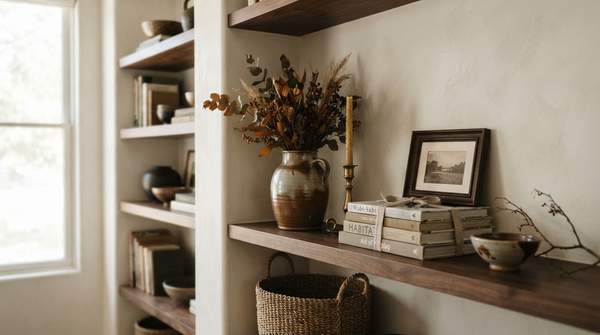
Curated clutter is not an oxymoron—it's a design philosophy. The difference between a display that delights and a pile that drains you comes down to intention. A designer writing for IDEO puts it plainly: "if clutter is made up of the things that have no home, curated clutter is made up of the things that make your home." That single distinction separates the two states, and it can be applied to any shelf, mantel, or tabletop you own.
Beyond Mess: Defining Curated Clutter
The IDEO designer who coined the phrase draws the line at disorganization. The clutter that drags people down, she writes, is "disorganized clutter—stacks of papers, discarded shoes, and items with no home." Her own home runs on the opposite principle: objects chosen deliberately, arranged with purpose, in whatever quantity suits the person. As she notes, curated clutter "could be five items or five hundred."
Writer Melissa Forbes, discussing what she calls the "collected home," frames the same idea as a way of living rather than a trend: buying things with personal meaning over time and using them to create spaces that feel lived-in and warm. She acknowledges the tension directly—wanting to be surrounded by loved objects without letting them consume the room, and without the display looking "overly curated and inauthentic." A layered home, she argues, is the point, but behind it sits "an intentional process of selecting what deserves to be seen."
So the definition holds across sources: curated clutter is abundance with a governing intelligence. Disorganized clutter is accumulation without one.
The Psychological Impact: Clutter vs. Curation
Why does the distinction matter beyond aesthetics? Because disorganized clutter carries a documented psychological cost. An article on clutter psychology from the art and design college RMCAD states that clutter "isn't just a physical problem; it's also a psychological one," and that disorganization "can fuel stress, distraction and fatigue."
The mechanism, as RMCAD describes it, is cognitive. Clutter "causes chaos, the brain not knowing how to prioritize attention among distractions, which makes it difficult to focus," and the visual distractions it creates "overload the brain, reducing working memory." The same article connects organized interiors—those supported by functional and aesthetic design—with the ability to "nurture calm, focus and emotional balance."
The IDEO writer reports the same research from the other side, noting that multiple studies have linked cluttered workspaces to procrastination, stress, and even life dissatisfaction—while describing her own curated environment as having the opposite effect for her. What the evidence supports is a contrast: disorganized clutter is associated with stress and cognitive strain, while intentional, meaningful display contributes to a sense of home and personal meaning. The claim is not that curation is a medical fix—it's that the two states sit on opposite sides of a real psychological boundary.